Saturday, November 9, 2013

Jerusalem Day 3


Today we started our day with a trip to Bethlehem, which is basically a suburb of Jerusalem, with one big difference compared to a US metropolitan area.  Bethlehem, which is in the West Bank, is a Palestinian territory so our Jewish Israeli tour  guide could not join us, and we passed through a border control area on the way.  There is also a fence between the Palestinian territory and Israel.  That being said, this day, along with every other day, has been uneventful and safe.  

We viewed the Shepherds Field and the Church of the Nativity.  The field and cave pictured below are representative of the fields where the angels announced Jesus's birth to the shepherds.


The Church of the Nativity was the traditional site of Jesus's birth.  It was a very crowded venue with a long wait and a climb down to the 'location.'  It was too dark and crowded to get good photos.  
However ther was another church with some nice frescos, below.


We returned to the Old City of Jerusalem for a quick lunch of falafel in a pita and the hoofed it to the Church of the Sepulchre.  A few days ago we visited the Garden Tomb, the site of Jesus death and burial.   However, different Christian religions have different venues for the major events for a variety of reasons and the Church of the Sepulchre is the traditional spot for most of the denominations.  We did see a processional of the Greek Orthodox Archbishop and his staff while waiting to get in.  This place was also hard to get photos in - dark and crowded.  This church was huge and had many different areas.  

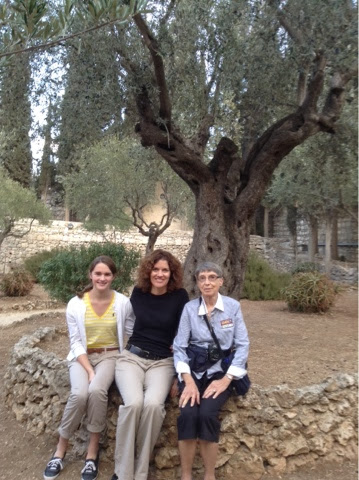
We took another hike through Old Jerusalem with our destination being the Garden of Gethsemane.  After a day of bustling cities we enjoyed some quiet time in the Garden of Gethsamane with just our tour group of 20 and took the photo below.


This area is maintained by the Francisans and also has a beautiful church, in which a mass was being said when we entered. The facade of the church is below.


We had a very interesting day of religious history.  It's amazing to be in a place where the Islam daily prayer call can be heard while you are stepping into the Church of the Sepulchre, with the ruins of the Jewish temple just hundreds of feet away.

Karen

Friday, November 8, 2013

Jerusalem Day 2 and Masada

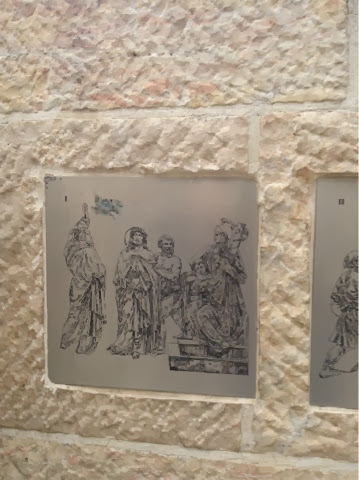
To start today, we went back to Old Jerusalem.  We saw stations 1 and 2.

The first station^^^
The second station^^^
After that, we we through the tunnels of Old Jerusalem.

The view^^^

Pillar from Herodian times^^^
There really wasn't much to see in the tunnels except for cisterns and rocks.


The healing pools of Bethseda.  This is actually where Jesus performed some of his miracles.^^^
Right next to the pools is St. Anne's Church.  It is supposedly where Mary was born.

Outside of the church^^^

Statue of Mary and Jesus and the candles that you can light when you go into the church.^^^

Looking up^^^

Looking out the door^^^

The altar^^^

The place where you could kneel and pray (on the left hand side)^^^

Statue of someone (to the left)^^^

The supposed actual birthplace^^^

Statue of Mary^^^

Afterwards, we had to leave through the St. Stephen gate (this one is for you, Dad).  It is also called the Lion's Gate.

Do you see the four lions? ^^^

In the afternoon we visited Masada, a huge mesa located at the southern Israeli edge of the Dead Sea.  It was here, in about 70 A.D., that the last of the Jewish zealots were encamped while the Roman army was crushing the rebel holdouts in Jerusalem.  There were 960 people encamped on the Masada, on which was one of King Herod's several palaces and fortifications.  Herod had sufficient provisions of food and water to last for 3 years.  A huge Roman detachment was ordered to harass the Jews until they surrendered.  History is a bit uncertain as to the time lapse between the beginning and end of the siege.  However it is known that the Roman army eventually built sufficient ramps and artillery to smash down the walls and burn the gates.  The Jews in view of defeat devised a plan to die honorably instead of giving the Romans the pleasure of a final massacre.  The men killed their wives and children and the final ten men killed each other.  The final man had to kill himself.  It is believed that two women and three children hid out in a very deep cistern and were later freed.  The ruins include Herod's palaces, the bathhouses, the garden area, the large storehouses, the columbarium, the cisterns, a later church, and a military area.  The Roman encampment and ramp areas below are visible, and the lay of the land suggests how the water was captured from nearby rivers.  Access to the top was by the Snake Path, a long and dangerous climb.  Today, cable cars take tourists and workers up and down in safety and comfort.  Our day was perfect, being warm and partly cloudy, without much wind.  On the way back to Jerusalem, we stopped at En Gedi, where David was being chased by King Saul, as recorded in the book of Samuel.  A bit further down the road, our bus broke down, but we were soon rescued and safely back in Jerusalem.  

A model of what it would've looked like^^^

Bathhouse with original paint^^^


Original tile^^^


The view overlooking one of the levels of the palace^^^

The view^^^


King Herod's bedroom; definitely a room with a view^^^


The storehouses^^^

Cool jug; called a special name because of its two handles, but I can't remember what it is called^^^

View again^^^

Yet another old mosaic^^^


My mom and I in front of the view and the Dead Sea^^^

Tomorrow we are going to Jericho and Bethlehem.  

P.S.  I was walking and I saw a woman in a head scarf and a dress that reached up to her neck, past her wrists, and down to her ankles.  The interesting thing about it was that she had spike stiletto Christian Louboutins on.  It was just kinda funny how she mixed something very non-traditional with something very traditional.

-Meghan and Carol


Thursday, November 7, 2013

Dead Sea and Jerusalem Day 1

Today we went floating in the Dead Sea.  We didn't get any pictures because it was sandy and we didn't want to ask our fellow foreigners to take our picture.

View of the Dead Sea; it was very hazy ^^^

Grandma and Mom^^^

My Mom and I^^^

Me in front of it.  This picture shows how hazy it was^^^

The view to the right of it^^^

After the Dead Sea, we took about a 25-minute bus ride to the Jordan-Israel border.  We had to go through customs and all that jazz, and it took about 2 hours.  When we finally got through, our tour guide decided to take us to a part Old Jerusalem and the Garden Tomb today instead of tomorrow.  Old Jerusalem is the original walled city and the Garden Tomb is a tomb where they think Jesus might be buried.  


The Wailing Wall, which is part of the Jewish Quarter of Old Jerusalem, is where people come and write their prayers on a piece of paper and then stick it into the cracks of the wall.  It was divided between male and female, which I found kind of odd.  

After the Wailing Wall, we ventured into the Muslim Quarter of Old Jerusalem.  It was loud, scary, and I thought I was going to get lost.  Guys were going past on mopeds and bikes.  With it being so crowded,they had to weave in between everyone and our group almost got split up.  The mentality of everyone there was, "Get out of my way, because I'm not getting out of yours."

Along the way, their were Stations of the Cross. The Crusaders established it in 1099.  We saw the third, fourth, and fifth.  

The third station, where Jesus fell.  It said, "Catholic," so I deemed it as important.^^^

The fourth one,  where Jesus met his mother.^^^

The fifth one, where Simon helped Jesus.
The Damascus gate.  The eight gates are named for which main city they face toward.

After Old Jerusalem, we went to the Garden Tomb.  The first reason they think it is where Jesus is buried is because of the rock formation nearby.  It used to actually represent a skull (remember Jesus was crucified on Golgotha, or the Place of the Skull), but now it has eroded.

The rock formation now ^^^

The rock formation 100 years ago ^^^

The tomb^^^

The inside.  The tomb held three or four people and where we stood was called the mourning room (which is pretty self-explanatory.

Cool sign on the door^^^


Picture of my mom and I in front of the tomb.  Sorry for the blurriness of the photo, it gets dark at around 5 and the iPad mini has no flash.

Tomorrow we are going to two other stations and going to Masada, which is where the Jews decided to stay and be killed, rather than submit to the Roman power.

-Meghan